When Intelligence Becomes Cheap, What Becomes Valuable?
The Repricing of Scarcity in the AI Era
Originally published in collaboration with MAGIC Fund’s Magical Insights.

Where competitive advantage moves — and what that means for founders, companies and investors.
A founder sends over a deck. The story is tight, the market analysis is sharp, and a working prototype is one click away.
A few years ago, that combination told you something. It suggested a capable team had spent significant time researching a market, building a product and articulating a strategy. Today, much of that work can be compressed into days — sometimes hours.
That does not mean the company is weaker. Quite the opposite: AI is giving exceptional founders extraordinary leverage. But some of the signals investors historically relied upon now tell us less than they once did.
And the shift goes far beyond pitch decks. AI is lowering the cost of coding, research, analysis, design and experimentation. Small teams can build faster, test more ideas and achieve levels of capability that once required significantly more people and capital.
That creates an important question for investors:
When intelligence becomes abundant and inexpensive, what remains scarce — and therefore valuable?
I believe the answer has implications for how we assess companies, where competitive advantage sits, what investors are ultimately paid for and, eventually, how capital itself needs to evolve.
01 When signals get cheaper, they tell us less
Economists have long distinguished between ordinary information and costly signals: things that are credible partly because they are difficult for a weaker participant to reproduce.
Venture capital has historically contained many of them. A sophisticated prototype required technical capability. Deep market analysis required time and expertise. A polished product required engineering and design resources. AI is rapidly reducing those costs. The result is a paradox: the average company an investor encounters may look considerably better at precisely the moment when appearances become less informative.
Research in other markets already points in this direction. One study of Freelancer.com found that after large language models arrived, written job proposals became less useful in predicting subsequent performance. Employers shifted toward harder-to-manufacture signals such as previous ratings and price.
The parallel to venture is imperfect, but the underlying problem is relevant. If almost every founder can arrive with sophisticated analysis, compelling materials and a functioning product, investors have to move further down the evidence stack.
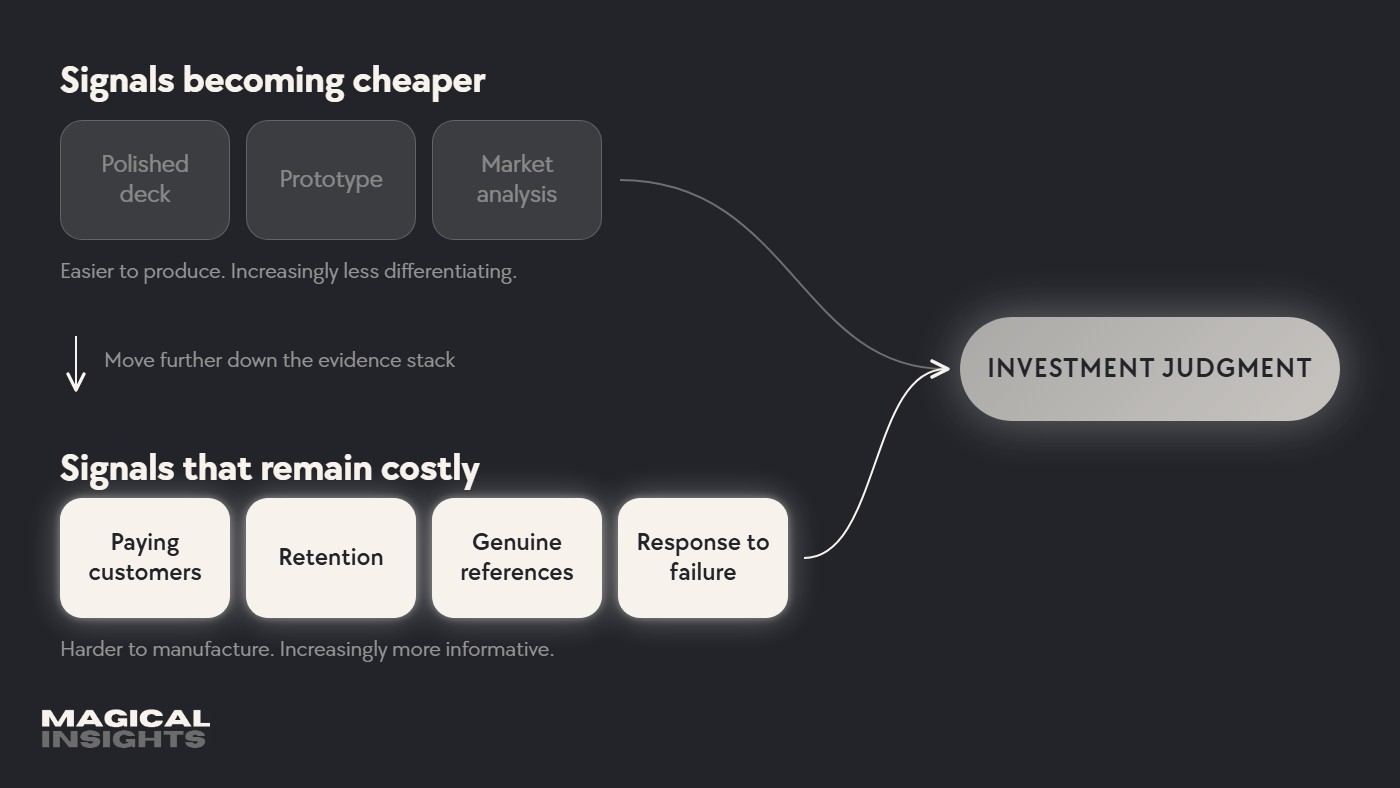
A paying customer is harder to manufacture. Retention over time is harder still. A customer willing to put their reputation behind a reference tells us something. And how a founder responds when the original plan fails may tell us more than how convincingly they presented the plan in the first place.
Across the companies and founders I have encountered as an investor, I have increasingly found that the distinction that matters is between what looks impressive at a moment in time and what has the capacity to compound. AI makes that distinction more important.
02 Competitive advantage moves to what compounds
When something becomes abundant, value tends to migrate toward what remains scarce.
Technological invention alone has rarely guaranteed economic capture. David Teece famously explored this in his work on profiting from innovation. RC Cola introduced canned cola before Coca-Cola and Pepsi, but once the innovation was proven it could be replicated. The incumbents possessed something harder to recreate: distribution.
The lesson is even more relevant in an AI economy. If products can be built faster and features reproduced more easily, simply having a product becomes less defensible. What becomes harder to copy? Distribution. Customer relationships. Trust. Brand. Regulatory access. Proprietary feedback loops. Physical-world capabilities. And the organisational ability to execute repeatedly.
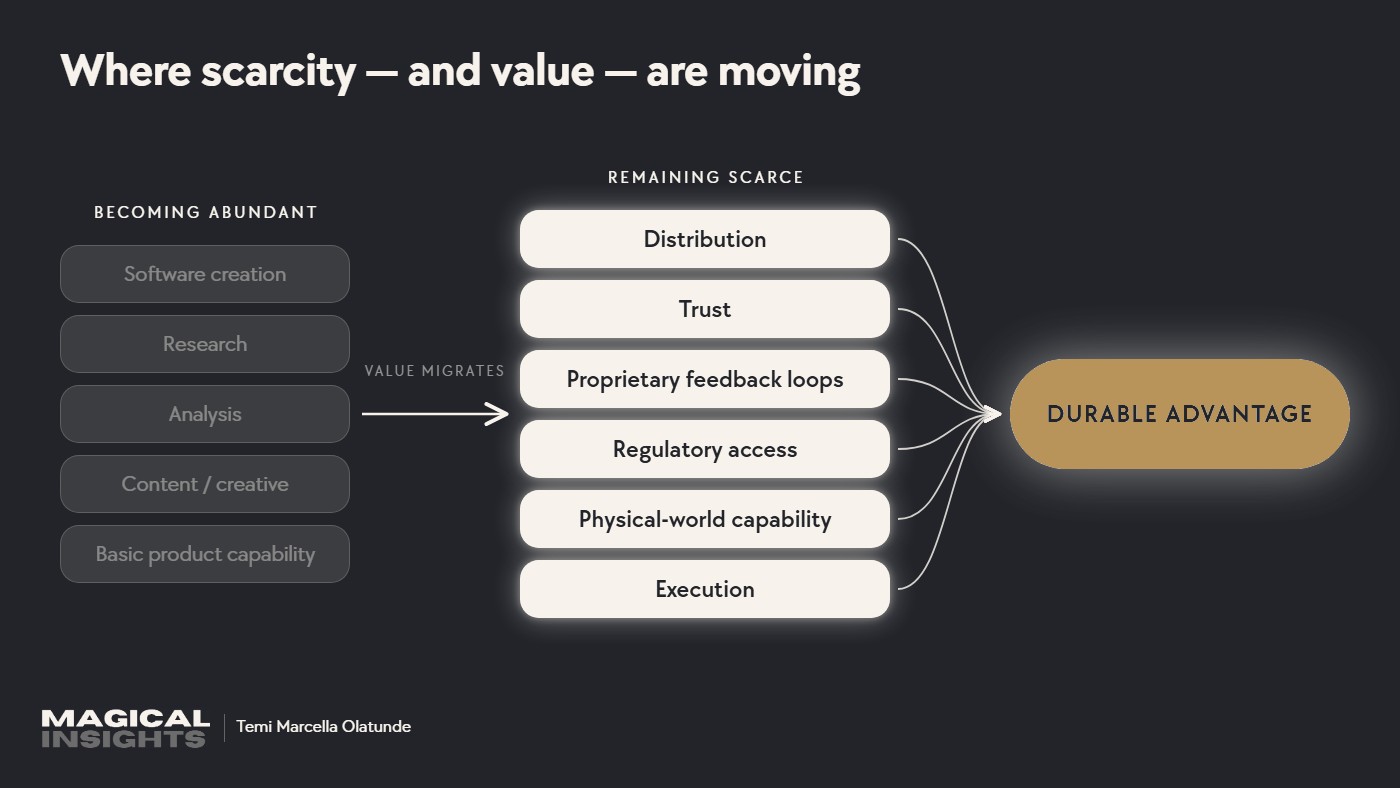
These advantages compound. A competitor can generate software overnight. It cannot generate five years of customers who have learned to rely on it. It can analyse a regulated market; it cannot instantly recreate years of regulatory relationships and permissions. Even proprietary data, frequently described as an automatic AI moat, deserves scrutiny. Data becomes strategically valuable when it is genuinely difficult to obtain elsewhere, continues to improve outcomes and creates a feedback loop in which usage makes the product better.
So the question investors should increasingly ask is not simply what can this company build? It is:
What becomes stronger every time someone uses it — and how difficult is that advantage for the next company to reproduce?
03 Scarcity moves into the physical world
There is another paradox at the heart of the AI economy. Intelligence may become cheaper while the infrastructure required to deploy it at scale becomes enormously valuable. AI software can be reproduced at extraordinarily low marginal cost. Compute, semiconductors, power, data centres, connectivity and physical infrastructure cannot.
The same applies as AI moves into healthcare, manufacturing, energy and robotics. Intelligence alone does not deliver a medical intervention, build an industrial facility or move an object through the physical world. Regulation, infrastructure, supply chains, specialised talent and trusted distribution still matter.
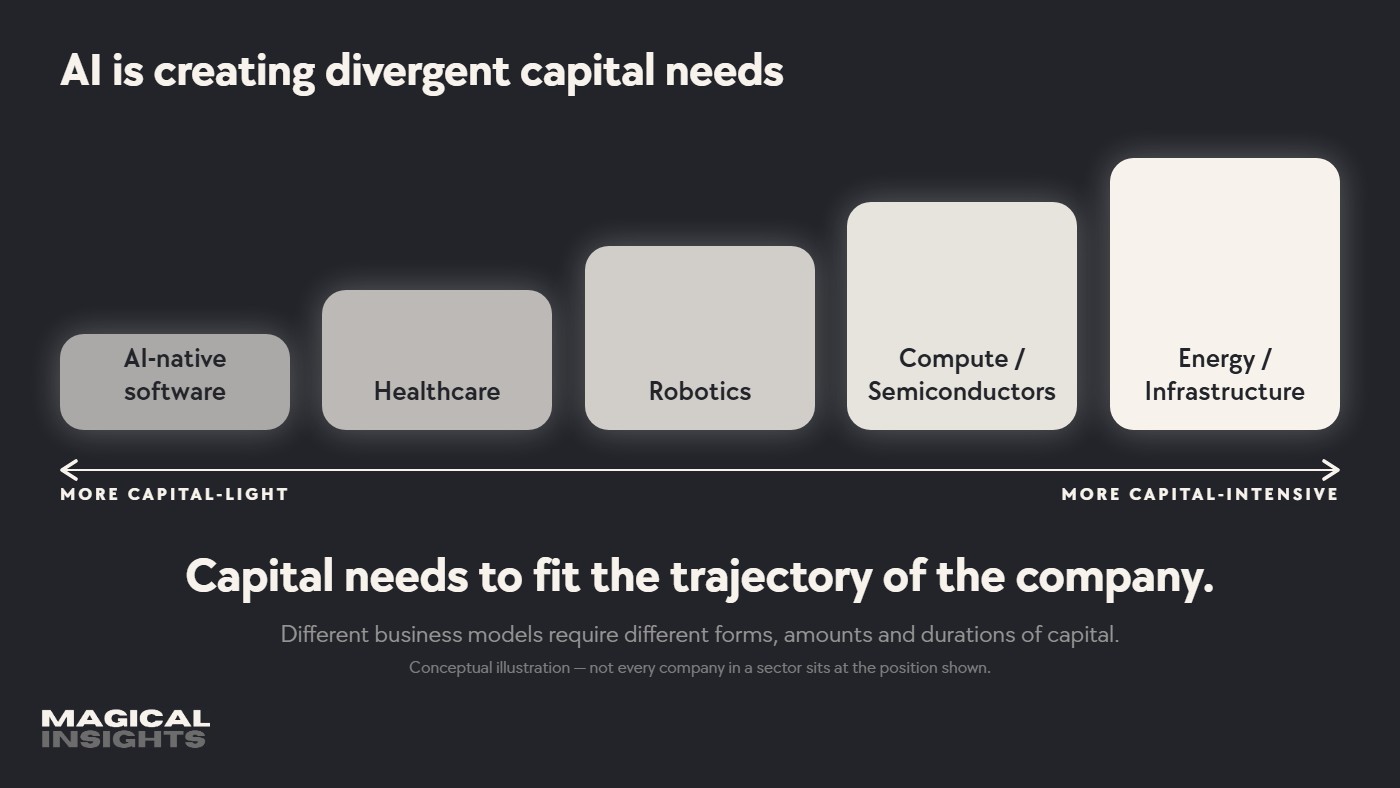
AI may therefore make parts of the economy dramatically more capital-light while making others significantly more capital-intensive. For investors, some of the most interesting opportunities may increasingly sit where abundant intelligence meets scarce real-world capability.
04 What is an investor being paid for?
The same scarcity framework applies to venture capital. Historically, venture advantage has come from some combination of access, capital, information asymmetry, networks and pattern recognition. AI puts pressure on several of these.
Information that once took an analyst days to assemble can increasingly be synthesised in minutes. Markets can be mapped rapidly. Companies can be screened and compared at enormous scale. Pattern recognition will not disappear. It will become more widely available.
Venture has always relied on recognising patterns: what exceptional founders look like, how categories develop and which early indicators correlate with later success. AI will become increasingly good at identifying established patterns across enormous datasets. The harder — and potentially more valuable — question is knowing when the pattern itself is changing.
Venture operates at the boundary where historical evidence becomes less reliable. The companies capable of producing extraordinary returns frequently look unusual precisely because they are building into markets that do not yet exist in their eventual form. That means judgment under uncertainty becomes more, rather than less, important. Not judgment instead of AI. Judgment amplified by AI.
AI can help an investor process information, challenge assumptions and recognise patterns faster. But investment still requires deciding which signals matter, which precedent is relevant and when precedent should be ignored.
Some of the most valuable information also sits outside formal datasets: what an early customer really thinks; why a talented executive chose one founder over another; how a regulator’s position is evolving; whether a team becomes more effective when circumstances deteriorate; what an experienced operator sees before it becomes consensus. Much of that information travels through relationships and trust.
So if intelligence and information become increasingly abundant, what is an investor ultimately being paid for? I think value moves toward judgment, relationships, reputation, access to non-obvious information and — critically — the ability to affect what happens after the investment is made. The advantage becomes less about access to deals and more about access to insight.
05 If companies change, capital must change too
There is one further implication. If AI changes the economics of building companies, we should not assume that the capital designed to finance them can remain unchanged.
At one end of the spectrum, AI-native software businesses may reach meaningful scale with smaller teams and considerably less equity capital. At the other are businesses built around compute, semiconductors, energy, robotics, healthcare and physical infrastructure, where enormous amounts of long-duration capital may be required.
Founders will therefore need different combinations of equity, strategic capital, debt, follow-on funding and liquidity at different moments. The implication is bigger than changing cheque sizes. Capital increasingly needs to fit the trajectory of the company rather than requiring the company to fit the architecture of the capital.
For venture investors, that may require greater flexibility in how companies are supported over time. The broader implications for fund structures — and the traditional boundaries between venture, growth equity and other forms of private capital — deserve a discussion of their own.
06 The larger question
AI will not eliminate scarcity. It will relocate it.
As intelligence becomes abundant, the premium moves toward what cannot simply be generated on demand: trust earned over time, distribution built relationship by relationship, proprietary feedback loops, judgment when precedent fails, real-world infrastructure and the ability to turn intelligence into action.
That changes what investors should look for in companies, what founders should build around and what they should expect from the investors sitting around their table. The next era of venture will not be defined simply by who has access to the most intelligence. Soon, extraordinary intelligence will be available to everyone.
The advantage will belong to those who can identify what remains difficult to replicate, understand where value is migrating — and position themselves before that scarcity is obvious. So perhaps the defining investment question of the AI era is not what intelligence can create, but: